How to Style a Silk Scarf: 8 Elegant Styling Options


There is a particular kind of confidence that comes with knowing exactly how to style a silk scarf. It is quieter than the confidence of wearing an expensive bag or a bold piece of jewelry. It is the confidence of understanding, of knowing what a material is capable of, how it responds to different configurations, and how to place it in the composition of a look so that it appears to have always belonged there.
Silk is the most expressive of the scarf fabrics. It is not the warmest, and it is not the most structured, but it has a quality of luminosity that no other natural fiber quite replicates. Woven from the continuous filament of the silkworm cocoon, silk possesses a natural triangular cross-section that reflects light differently at every angle, which is why a fine silk scarf appears to move even when perfectly still. This responsiveness to light is also what makes silk so demanding of the right styling choices: a tight, forced knot will dull it; a loose, fluid arrangement allows it to perform.
For women who understand the value of an accessory that works across decades rather than seasons, learning how to wear a silk scarf across every context, the office, the evening, the Sunday afternoon, the long flight, is one of the more rewarding investments of time a wardrobe can ask of you. These eight methods are built for exactly that.
Why Silk Requires Its Own Approach
Most guidance on wearing scarves treats all fabrics as interchangeable. They are not. Silk wants movement and space. It does not hold a structured knot the way cashmere does, and it does not have the thermal logic of a wool blend that earns its place at the neck on a cold morning. What it has instead is versatility across registers, from precise and professional to loose and entirely effortless, and a visual quality that makes even the simplest styling method appear considered.
Understanding how to style silk scarf pieces well is largely about working with that fluidity rather than against it. Every method in this guide is built on that principle. The configurations here are the ones that allow the silk to do what it does best.
The silk scarves in the Maneesha Ruia collection are hand-painted using AZO-free dyes that preserve the fiber's natural luminosity across years of wear, a distinction that is visible in daylight and unmistakable in evening light.
The Neck Tie
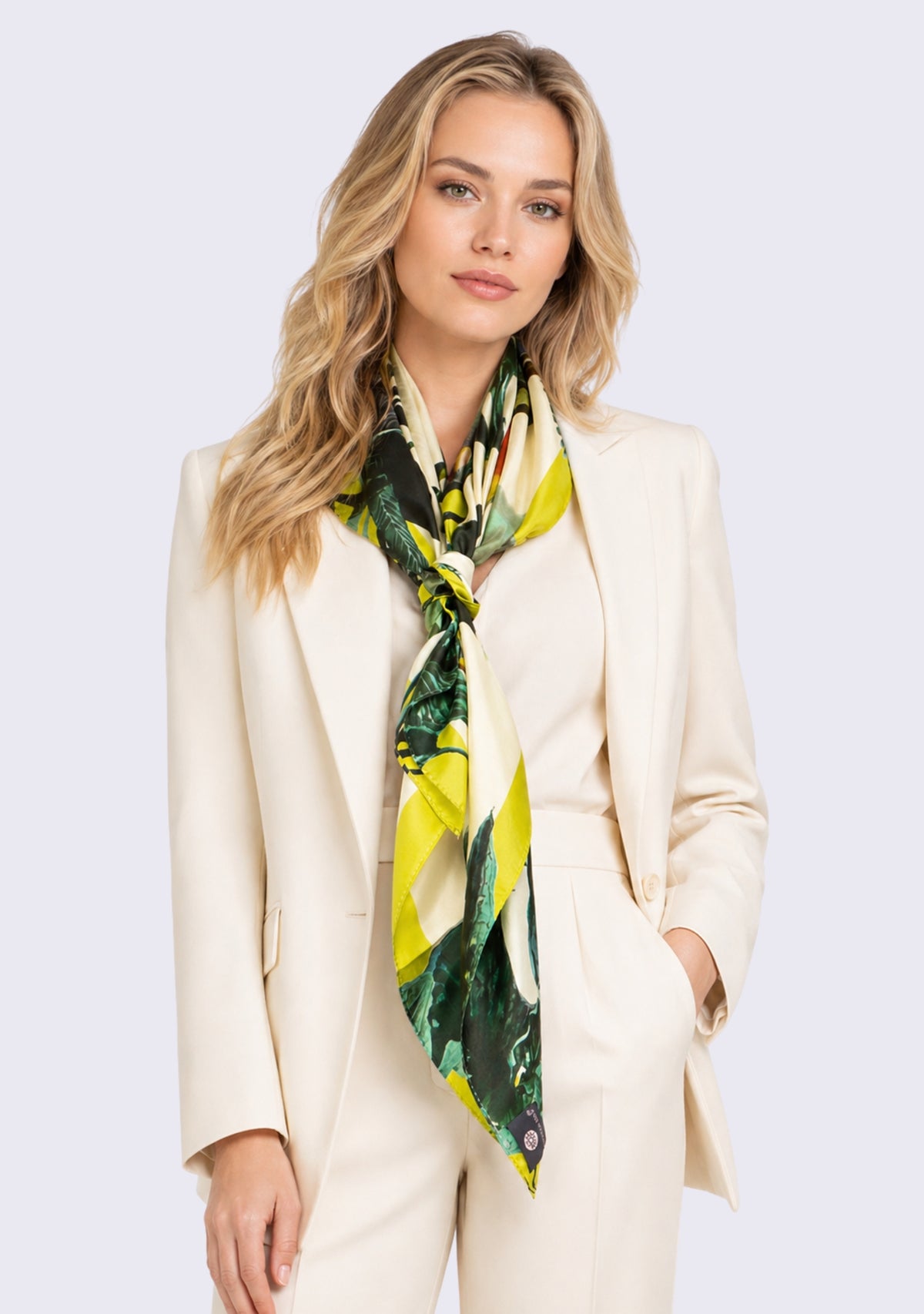
The necktie is the most precise and immediately recognizable application of a fine silk scarf. Fold the scarf by bringing both long edges toward the center, then fold again until you have a strip approximately two to three inches wide. Drape it around the neck and tie in a single loose knot at the base of the throat. Let the ends fall freely over a blouse, or tuck them under an open collar for a more contained effect.
Knowing how to wear a silk neck scarf in this configuration is the difference between an outfit that is dressed and one that is dressed with a point of view. It transforms a simple blouse and well-cut trouser into a look that appears fully considered. The key is the knot itself, loose, sitting naturally, appearing entirely unhurried. Silk tied tightly loses the quality that makes it worth wearing.
This is also the styling method that travels most easily across contexts. Worn at the base of the throat over a fine knit on a cool morning, it reads as elegant weekend dressing. Worn over a silk blouse in a professional environment, it reads as authoritative and artfully personal.
The Loose Shoulder Drape
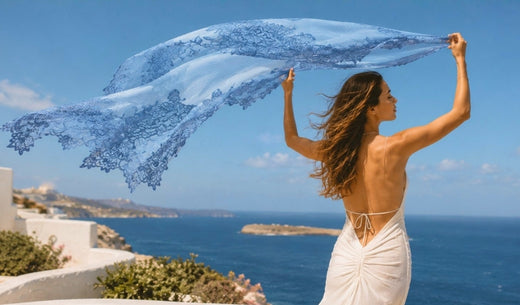
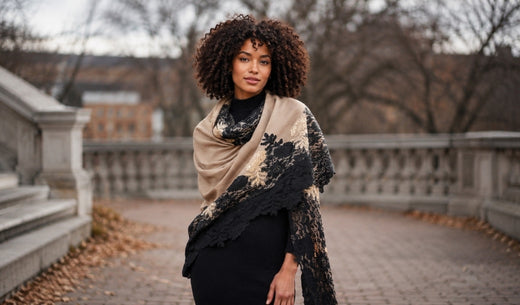
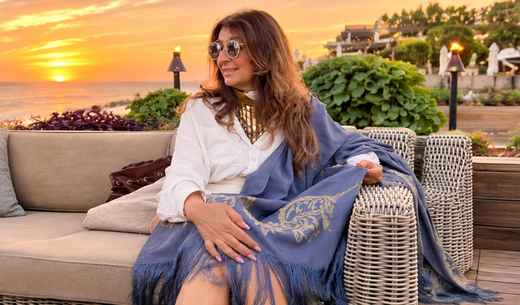
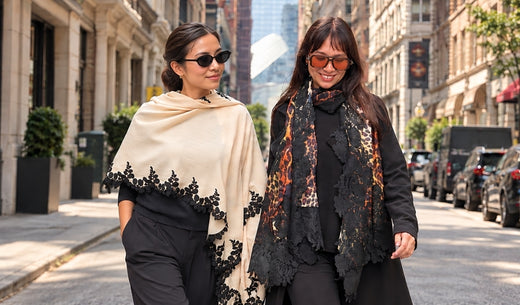
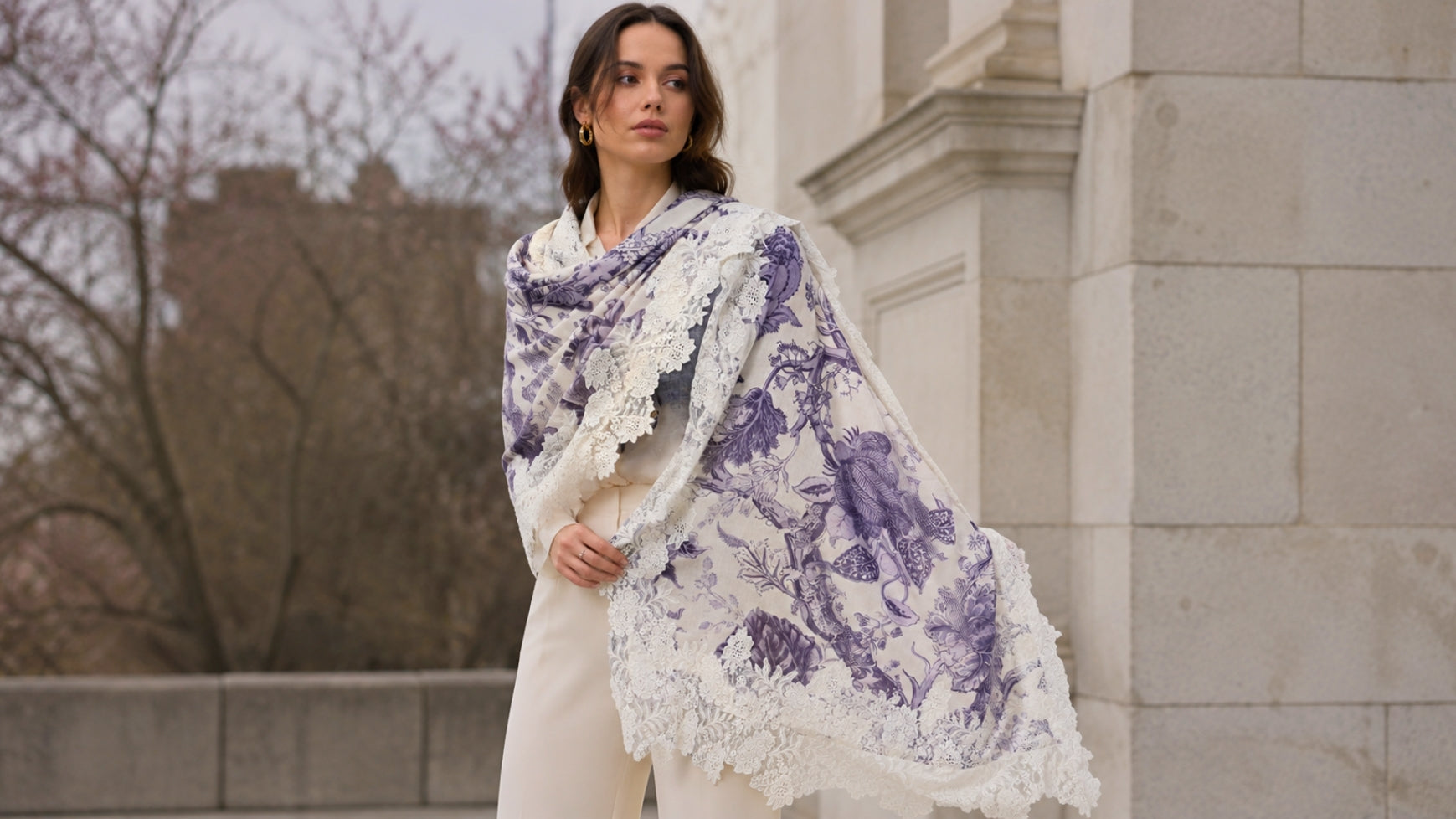
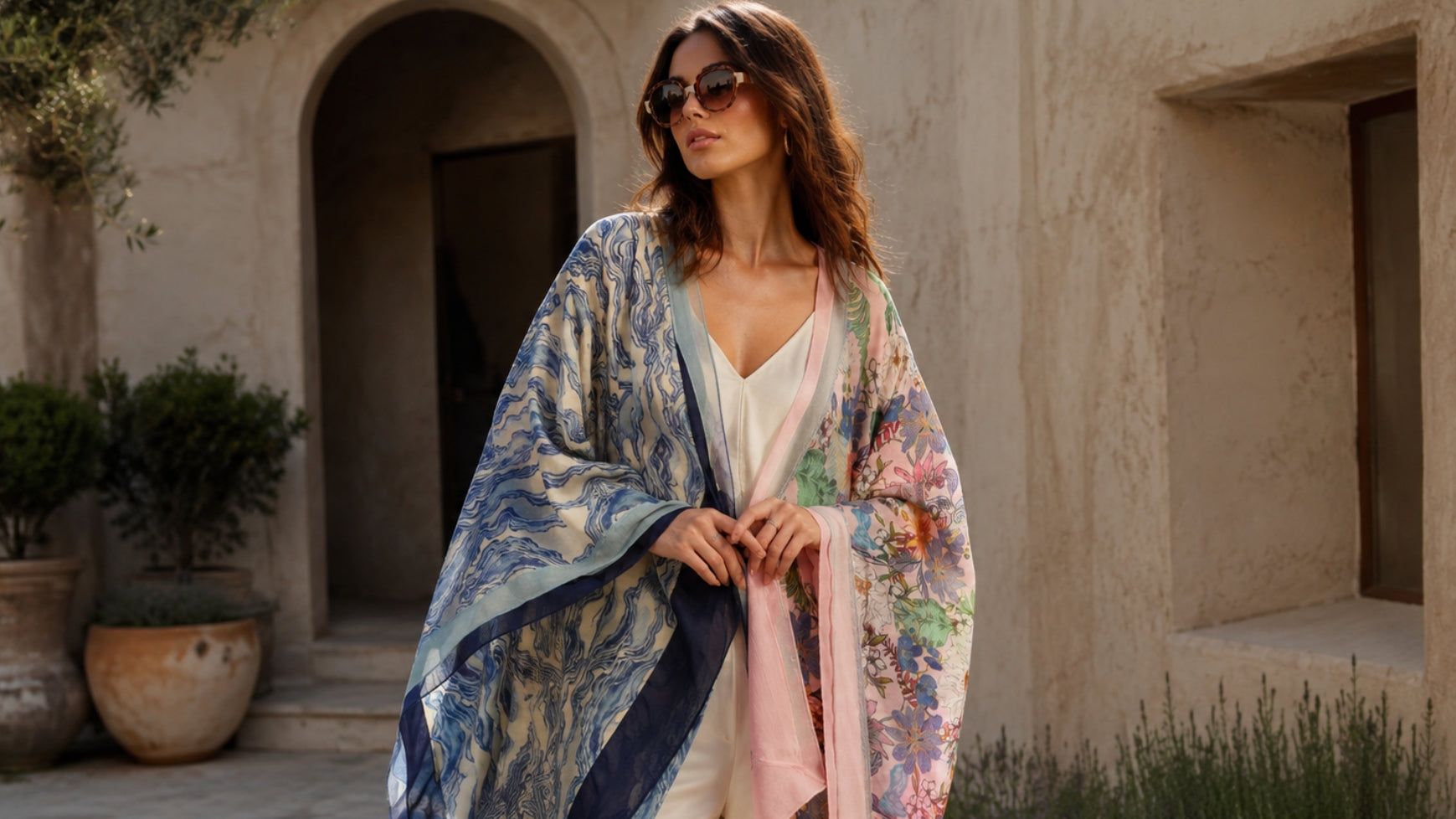
The loose shoulder drape is the most understated way to wear a silk scarf, and in its understatement, frequently the most effective. Open the scarf to its full width and lay it across both shoulders, allowing both ends to fall forward over the chest in equal lengths. Do not knot, tuck, or fasten. Allow the natural weight of the silk to hold the fabric in place.
This works with particular elegance over a sleeveless evening dress or a fitted column silhouette, where the moving ends of the scarf introduce dimension and a quality of softness without disturbing the clean line of the underlying look. The method asks nothing of the wearer except the willingness to leave it alone, which is, in practice, where most women struggle most with fine fabrics.
The Santa Cruz Print Silk Square Scarf, inspired by the coastal ease of Maneesha's travels and finished with a luminous sheen, carries exactly the kind of print presence that rewards this kind of generous, unstructured treatment. Opened to its full width across the shoulders, the print reads as a complete composition, not a fragment of one.

The Hair Wrap
Fold the scarf diagonally in half to form a long triangle, then roll it from the pointed tip toward the folded edge until it becomes an even, smooth band. This band can be tied around a low ponytail with the ends trailing at the nape of the neck, wrapped across the crown and knotted at the back as a wide headband, or looped once and tied at the side of a low bun.
Silk is the only fabric that performs reliably in this application. Its natural smoothness means it will not snag, pull, or create friction against the hair, and the sheen of the fiber shows beautifully against any hair color. A printed piece with bold color or a graphic pattern reads with particular impact here; the hair carries the print in a context that no other accessory placement quite replicates.
It is among the most effortless styling choices available and among the most consistently striking in result. Women who discover this application of a fine silk scarf tend to find it becomes the one they reach for most often.

The Bag Tie
Threading a silk scarf through the handle of a structured bag is the styling choice that signals a complete understanding of how accessories function, not as isolated items but as a composition. Pull the scarf through the top handle of a leather tote, a saddle bag, or a top-handle piece, and tie it in a single loose knot. Not a bow, not a complicated arrangement. A knot, allowing the two ends to fall at different lengths.
The Santa Cruz Silk Square Scarf works well here, but so does any lightweight printed piece whose color picks up something from the bag or the outfit. This is the detail that registers as an impression before it registers as a deliberate choice, which is the standard that the best styling decisions are held to.

The Neck Loop: Wearing a Silk Scarf Around Your Neck
For a more structured answer to how to wear a silk scarf around your neck, one that stays in position without constant adjustment, the neck loop offers exactly that. Fold the scarf in half to find the midpoint. Place that midpoint at the front of the neck, bring both ends around to the back, cross them once, and bring them forward again. Tie in a loose, flat knot at the center of the chest.
The result is a layered, composed configuration that sits close to the body and moves with it rather than against it. Unlike the European loop, which works best in heavier fibers, the silk neck loop is intentionally fluid, the fabric settles into a natural position and stays there without holding a rigid form. It is a reliable method for women who want the visual impact of a scarf at the neck without the sense that they are managing it throughout the day.
The Shoulder Knot
The shoulder knot is one of the more sculptural ways to wear a silk scarf, and it works precisely because silk holds a loose knot with a quality of softness that stiffer fabrics cannot replicate. Lay the scarf across both shoulders and gather the two ends over one shoulder. Tie them in a single, large, relaxed knot, generous rather than tight, and allow the remaining length to fall downward.
The knot creates a focal point at one shoulder, shifting visual weight to that side and producing an asymmetric silhouette that reads as modern and deliberate. Over a strapless neckline or a wide, square-cut top, the shoulder knot serves both a practical and a compositional function simultaneously. It is an effective choice for occasion dressing and for evenings where a single, clear point of interest in the outfit is more compelling than multiple competing ones. The full occasion wear scarves collection at Maneesha Ruia includes pieces designed with exactly this kind of elevated moment in mind.
How to Wear a Long Silk Scarf: The Vertical Drape
A long silk scarf worn vertically is one of the most confident ways to engage with the full length of the fabric, and one of the most flattering ways to use it. Place the center of the scarf at the back of the neck and allow both ends to fall forward in equal lengths down the front of the body. Then lift one end and carry it across to the opposite shoulder, allowing it to fall down the back.
The asymmetry that results draws a clean, elongating line on one side while the movement of the trailing back end introduces dimension from behind. Over a slim trouser and a tailored blazer, or over a long dress at an evening event, this configuration is exceptional. A hand-painted or gradient-dyed long silk scarf, where the color itself changes across the full length of the fabric, rewards this treatment specifically, because the vertical hang allows the full arc of the color to read as it was designed.
How to Wear a Square Silk Scarf: The Classic Fold
The square silk scarf is the most historically enduring form the accessory takes, and the classic fold is its most definitive expression. Fold the square diagonally in half to form a triangle. Roll or fold the triangle from the point toward the folded edge until you have a neat, even band. Tie it at the front of the neck in a simple knot, or at the back with the triangle point left visible below the knot at the neckline.
Worn low at the neck over a V-neck blouse or a fitted top, a square silk scarf in this configuration introduces color and print with precision and control. It is the method that has remained in continuous use across every decade since the 1940s, not because it is fashionable but because it works. It asks only a single knot and rewards that request completely.
The Santa Cruz Print Silk Square Scarf, with its travel-inspired coastal print and soft, luminous drape, is one of those pieces that was designed for exactly this configuration, among others. It is equally effective as a hair wrap, a bag accent, or an open drape at the shoulder.
Choosing the Right Occasion for Each Method
Understanding how to style a silk scarf across contexts comes down to matching the method to the energy of the occasion and the register of the surrounding outfit.
For professional environments, the neck tie and neck loop are the methods that introduce color and texture without softening formal authority. A tone-on-tone piece, ivory, deep navy, charcoal, provides the luminosity of silk without making the scarf the center of attention.
For social and semi-formal occasions, a printed or hand-painted piece worn at the shoulder in the loose drape or shoulder knot earns its place as the clear focal point of the look. A bold print at the shoulder makes every other accessory decision simpler, not more complex.
For casual wear, the hair wrap and bag tie are the methods that elevate the simplest outfit with the least intervention. A silk scarf tied through a bag handle or at the base of a ponytail takes ten seconds and produces a result that takes significantly longer to explain away.
A silk scarf, worn with any of these eight methods and in the right piece, does not supplement a look. It completes it.