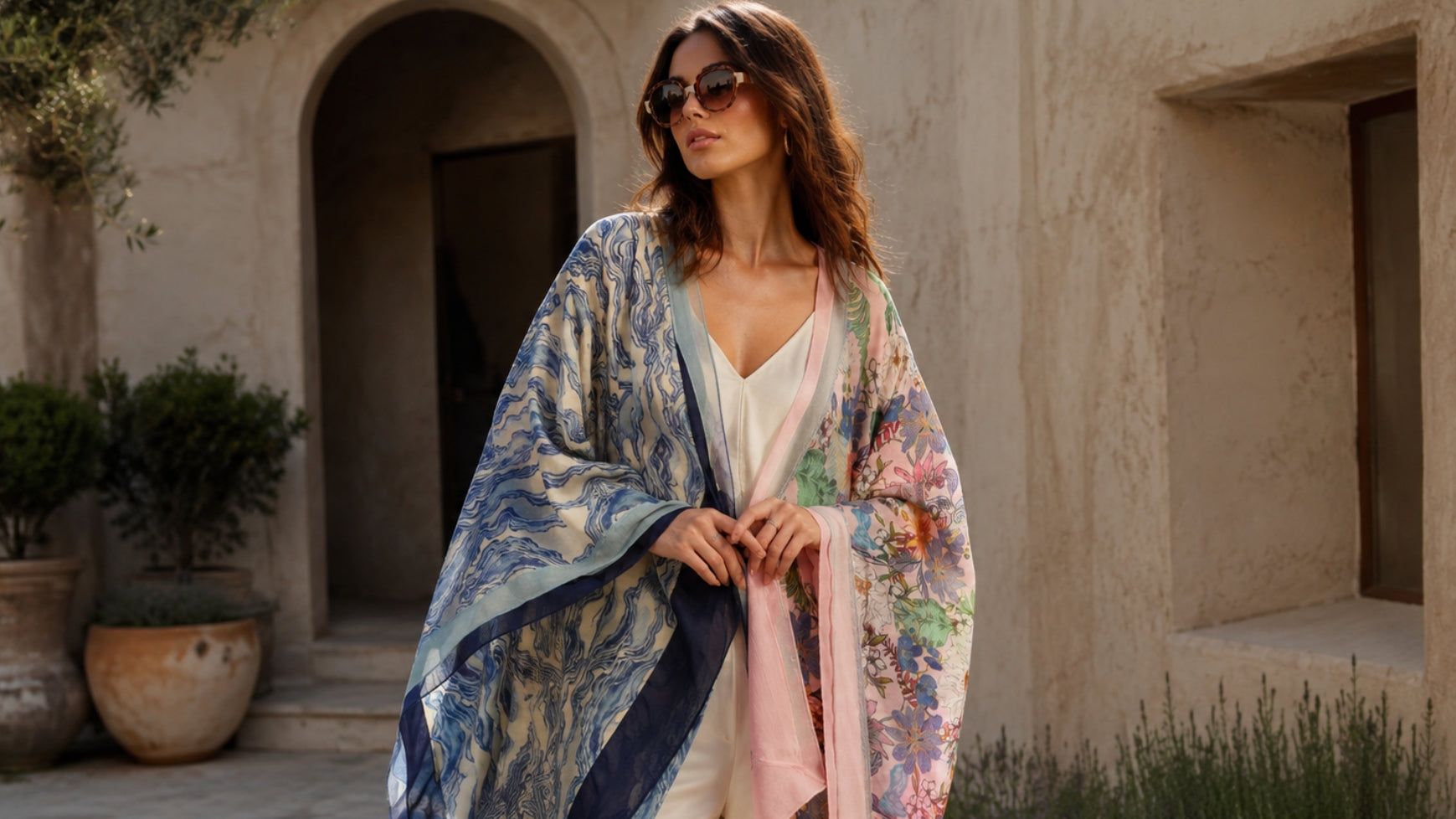
How to Wear a Square Scarf: 3 Easy Tying Methods


Of all the scarf shapes available to the considered dresser, the square occupies a particular position of versatility. Rectangular scarves are wonderful at the neck and shoulder. Long scarves drape and wrap with effortless warmth. But a square scarf, when properly proportioned and cut from the right fabric, does something none of the others can do with quite the same authority: it ties. It folds into clean geometry. It holds a knot without bulk. It transforms itself from neck accent to headscarf to bag ornament without losing the character of the piece.
Understanding how to wear a square scarf is, in the deepest sense, an understanding of proportion and fabric. A 40-inch silk square, cut cleanly and finished properly, is capable of a dozen configurations. Three of them, executed correctly, account for the majority of occasions a woman will encounter: the classic neck fold, the headscarf, and the bag accent. This guide covers all three, examines what makes a square scarf worthy of the techniques applied to it, and introduces the pieces in the Maneesha Ruia Vagabonde collection that make each method not simply functional but genuinely beautiful.
Why Silk Is the Definitive Square Scarf Fabric
Not every fabric performs well in a square format. Wool is too heavy for precise folding at smaller dimensions. Cotton lacks the drape and luminosity that the square format rewards. Cashmere, incomparable at the neck and shoulder, produces too much volume in the concentrated folding that a square knot requires.
Silk is different. Its natural protein structure gives it a weight that is at once present and light: enough to hold its shape through a careful fold, but light enough that a knot at the throat sits without pressure and a headscarf wrap stays without pins. The sheen of silk is also inseparable from what makes a square scarf beautiful. When the fabric catches light through a fold, it produces a luminosity no other material replicates. A well-placed silk knot at the neck reads, in good light, as something between jewelry and fabric, which is precisely what a considered accessory should do.
The silk square scarves in the Maneesha Ruia Vagabonde collection are woven from 100% pure silk at 40 by 40 inches, a proportion that has been the standard for the luxury square scarf since the mid-twentieth century, because it works across every configuration. Each piece in the collection is inspired by Maneesha's travels, the prints drawn from landscapes and natural forms encountered on her journeys, and translated into hand-finished silk with an exactness and depth that mass-produced alternatives cannot approach.
The Vagabonde Collection: Prints Worth Wearing
The Vagabonde collection includes five prints, each a study in the intersection of travel and refined artistry. The Santa Cruz Print Silk Square Scarf captures the coastal ease of that California landscape in a motif of painterly precision, blending scenic inspiration with the clean geometry that holds its form whether worn flat or tied. The Grand Prismatic Print Silk Square Scarf translates the extraordinary mineral colors of Yellowstone's hot springs into a palette of blues, oranges, and yellows that photograph beautifully and age with a depth that printed synthetics never produce. The Cockatoo Print and Toucan Print bring the architecture of tropical birds into a square format that is striking in the headscarf configuration and elegant at the neck. The Mammoth Hot Springs Print is the most dramatic in the collection, a composition of terraced mineral forms that reads as a work of art even before it is worn.

Each scarf is priced at $110 and arrives beautifully packaged in its own gift bag, which doubles as a storage and travel companion for the piece. Every scarf can be personalized with a monogram in gold, silver, or gunmetal Swarovski crystals, making them among the most considered gift options in the collection.
Method 1: The Classic Neck Fold
The classic neck fold is the configuration most associated with the luxury square scarf, and it earns its prominence because it is simultaneously the simplest and the most finished. Begin by folding the square diagonally in half to produce a triangle. Then fold the two outer corners of the triangle inward so the three points meet, forming a long horizontal band approximately four to five inches wide. Fold this band in half once more to concentrate the fabric and produce a clean, double-layered strip.
Take this strip and drape it around the back of the neck, bringing both ends forward to fall over the chest. For the loosest interpretation, leave the ends open and even, a simple drape that sits over a collar or against bare skin. For a more defined finish, tie a single loose knot at the center of the throat and allow the two ends to fall forward beneath it. For the most formal version, tie a small bow at the notch of the collar, keeping the loops compact and even.
This is the method that transforms a printed scarf into the dominant note of an otherwise restrained outfit. The Grand Prismatic Print worn this way against a white silk shirt, or the Santa Cruz Print against a navy linen blazer, creates a composition that is dressed without being formal. It is the choice for lunches, gallery visits, and any daytime occasion where the goal is to appear entirely at ease while having made a clear and considered decision.

Method 2: The Headscarf
The headscarf is the second great configuration for the square, and in silk it produces a result that references a long tradition of European style without feeling derivative or costume-like. Fold the square diagonally to produce a triangle, then fold the long edge over itself once to create a band of approximately two inches across the top. Place this folded edge along the hairline, bringing both ends behind the head and tying them at the nape of the neck.
For a fuller, more dramatic result, leave the triangle largely open and allow the pointed tail to fall down the back or tuck it beneath the tie at the nape. For a more streamlined version, fold the entire triangle into a narrower band before placing it, producing a thinner line across the forehead and a more minimal overall silhouette.
The headscarf configuration is at its finest outdoors, where the combination of movement and light makes silk behave at its most beautiful. As a summer scarf worn against the wind on a coastal terrace or in an open-top car, a silk square tied this way is a complete style statement that requires nothing added to it. The Toucan Print and Cockatoo Print from the Vagabonde collection are particularly suited to this configuration, their tropical motifs reading at their full authority when the entire surface is visible.

Method 3: The Bag Accent
The third configuration for the square scarf is the one that requires the least adjustment to the outfit but produces the most immediate visual effect. Fold the scarf diagonally to a triangle, then continue folding from the tip to the long edge until the triangle becomes a long, narrow band of approximately one to two inches in width. Tie this band loosely around the handle of a handbag, with both ends left free to trail.
The bag accent works because it introduces color, pattern, and the visual texture of silk into a space where most accessories never venture. A structured leather bag paired with the Grand Prismatic Print or the Mammoth Hot Springs Print becomes a composition rather than simply a carryall. The silk moves with the bag, the print catches the eye at a moment slightly after the bag itself, and the overall effect is one of those touches that reads as effortless while being entirely deliberate.
This configuration also functions as the most risk-free introduction to styling with a square scarf. If you are uncertain about wearing a bold print at the neck or in the hair, wearing it on the bag allows you to incorporate the piece, understand how the print reads in different lights, and build confidence with the configuration before applying it more directly to the body.
Choosing the Right Square Scarf for Each Method
Not every square scarf is suited to every method, and the differences come down to two factors: size and weight. The Vagabonde collection is cut at 40 by 40 inches, a dimension that is generous enough to allow the headscarf configuration without looking compressed, while retaining the precision needed for a clean neck fold. A scarf cut smaller than 36 inches loses options; a scarf cut larger begins to behave more like a shawl than a square.
Weight matters equally. Pure silk at the weight used in the Vagabonde collection sits in a middle register that performs well across all three configurations. A lighter silk crepe would produce a more delicate neck fold, but struggle to hold the volume in a headscarf. A heavier twill would tie beautifully but create too much mass at the neck for the restrained look the classic neck fold requires. The Vagabonde collection resolves these tensions through silk selection, and the result is a scarf that moves correctly regardless of configuration.
The choice of print matters too, though this is more a matter of preference than technique. Geometric or abstract prints such as the Grand Prismatic and the Mammoth Hot Springs fold and knot without the print becoming illegible. Figurative prints with clear subjects, such as the Cockatoo and Toucan, read best when the surface is largely open: the headscarf or the bag accent rather than a tight neck knot.
How to Style a Square Scarf Across the Day
The square scarf is one of the few accessories capable of moving through a full day without feeling misplaced at any point. In the morning, the classic neck fold over a cotton shirt reads as crisp and professional. At noon, untied and opened to a loose drape over the shoulders, the same piece becomes relaxed. By evening, retied as a precise bow against a cocktail dress, it closes out the day with a formality it can carry because the silk itself is inherently dressed.
This versatility is what makes the square scarf the single most efficient purchase available in the luxury accessories market. One piece, three configurations, and the full arc of a day covered with no change of bag, shoe, or garment required. The Vagabonde collection, at $110 per scarf, represents the most accessible entry point into this category of dressing that Maneesha Ruia offers. Each print is developed with the same attention to quality and detail that defines every piece in the broader collection.

Caring for Your Silk Square Scarf
Silk requires care proportionate to its beauty. The Vagabonde collection scarves are dry clean only, which is the correct approach for any printed silk where the dyes and print registration must be preserved across the life of the piece. No steam ironing; no ironing over any embellishment. Store the scarf folded rather than rolled, in the gift bag it arrives in, away from direct sunlight and in a cool, dry environment.
With this care, a Vagabonde silk square will retain its color, its drape, and its precision across years of wearing. The gift bag that accompanies each scarf is designed with this in mind: it is a storage solution as well as a packaging decision, the kind of detail that distinguishes a piece designed to last from one that simply costs a great deal.
The Final Note
Knowing how to style a square scarf and choosing the right one is the beginning of a long and rewarding relationship with one of the most versatile accessories a wardrobe can contain. The three methods in this guide are a starting point. Over time, with the right piece in hand, you will find variations and combinations that belong specifically to your own way of dressing. That process of discovery is part of what an accessory worthy of the name allows.
For those interested in extending the practice across seasons and fabrics, the full range of black scarves in the Maneesha Ruia collection offers the same quality standards applied to a palette that performs across every occasion from morning through evening and from summer warmth through the deepest months of winter.