How to Wear a Pashmina Scarf: A Complete Styling & Care Guide


Of all the luxury fibers available to the considered dresser, pashmina occupies a position that nothing else quite fills. It is lighter than wool and warmer by weight than almost every natural fiber you could reach for. It is softer against the skin than standard cashmere. It compresses to the size of a paperback and weighs almost nothing in a bag. And when it is worn correctly, draped across the shoulders, folded at the neck, or wrapped loosely over an evening dress, it carries a quality of effortless authority that decades of wearing teach you to recognize immediately.
Understanding how to wear a pashmina scarf is not simply a matter of knowing where to place it on the body. It is about understanding what the fiber is capable of, which occasions call for it, and what it requires in return, because a pashmina that is properly cared for does not simply last. It improves. The drape deepens, the hand softens, and the piece becomes something that improves with every careful season of wear.
This guide covers all of it: what pashmina actually is, what distinguishes a genuinely premium piece from a diluted substitute, six ways to wear it across every occasion, and the complete care protocol that protects an investment worth protecting.
What Pashmina Is, and Why Grade Matters
Pashmina comes from the word *pashm*, meaning soft gold in Persian, and it earns that name entirely. The fiber is drawn from the undercoat of the Changthangi goat, a breed native to the high-altitude plateau regions of Ladakh in northern India and the surrounding Himalayan zone, elevations that routinely exceed 14,000 feet, where winters are severe enough to drive the goat to grow an inner fleece of extraordinary fineness just to survive them.
This fleece is combed, not shorn, each spring. The fiber produced measures between 12 and 16 microns in diameter. Standard cashmere sits at 14 to 19 microns. Fine merino wool falls between 17 and 22. Sheep's wool ranges broadly from 20 to 30. The fineness of true pashmina places it at the very top of the natural fiber hierarchy, lighter, softer, and warmer by weight than virtually anything else available.
At Maneesha Ruia, the standard across the pure pashmina collection is Grade A, the most premium classification within an already exclusive category. Grade A pashmina is selected for exceptional fineness, processed with minimal mechanical intervention to preserve the natural crimp and elasticity of the fiber, and finished entirely by hand at every stage of production. The result is a piece that drapes with a softness that mid-grade fiber cannot replicate and holds its quality across decades of wearing and careful washing.
The Natural Superfine Cashmere Pashmina Scarf exemplifies this standard precisely. Fine enough to pass through a ring, versatile enough to wear from morning through evening, and available in eight colorways from classic neutrals through soft pastels, it is the kind of piece that enters a wardrobe and becomes the one you reach for without thinking.

Why Certifications Are Not Incidental
The pashmina market is wide, and it is not uniformly honest. Because the fiber commands a premium, diluted blends, mislabeled synthetics, and lower-grade cashmere substitutes are common in the broader marketplace. For a woman making a considered purchase, understanding what a brand's certifications actually mean in practice is not a minor detail; it is the difference between buying a piece that will last and buying something that will begin to disappoint within a season.
Every piece in the Maneesha Ruia collection is produced using GOTS-certified fabrics. The Global Organic Textile Standard verifies that a fiber has been processed, dyed, and manufactured in accordance with rigorous environmental and social standards from the raw material through to the finished product. It is not a label to be claimed; it is a certification to be earned and maintained.
The dyes used across all pieces are AZO-free. AZO dyes, a class of synthetic compounds common in mass-market textiles, are associated with the release of harmful aromatic amines. AZO-free alternatives are not only safer for the skin, particularly for women with sensitivities, but they maintain a depth, nuance, and color richness across the full life of the piece that reactive dyes cannot sustain over time.
All fiber is sustainably sourced through fair-trade partnerships that ensure the artisan communities engaged in combing, spinning, weaving, and hand-finishing the pashmina receive ethical working conditions and equitable compensation. These are not incidental details. They are the foundation of what makes a Maneesha Ruia pashmina an investment piece rather than simply an expensive purchase.
Six Ways to Wear a Pashmina Scarf
The Classic Shoulder Wrap
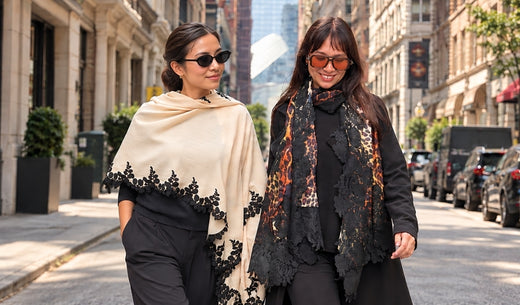
The most natural and instinctive way to wear a pashmina is as a simple shoulder wrap, and when the fiber is genuinely fine, it is also the most beautiful. Unfold the scarf to its full length and drape it symmetrically over both shoulders, allowing both ends to fall forward over the chest. Leave the ends loose and even in length, or carry one end across the opposite shoulder for a gentle asymmetry that introduces movement.
Over a fine-knit turtleneck, a structured blazer, or a flowing blouse, this is a piece chosen as much for what it communicates as for the warmth it delivers. The Natural Superfine Cashmere Pashmina Scarf in ivory or camel is the definitive version of this configuration, the kind of piece that appears on the body as if it always belonged there.
The Formal Shawl
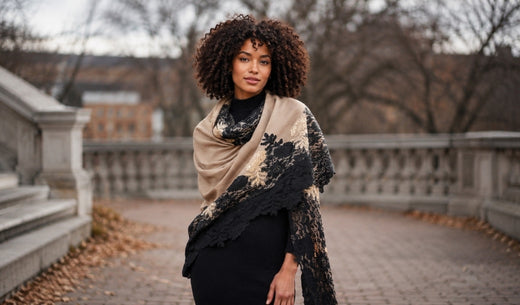
The formal shawl is the pashmina's highest occasion, the moment when its combination of weightlessness and warmth is both most acutely felt and most openly noticed. Open the pashmina to its full width across the back of the shoulders and hold both front edges together at the center of the chest. For a more secure position without pinning, cross the two ends at the front, pass each under the opposite arm, and allow them to fall down the back. The structure holds through an entire evening without adjustment.
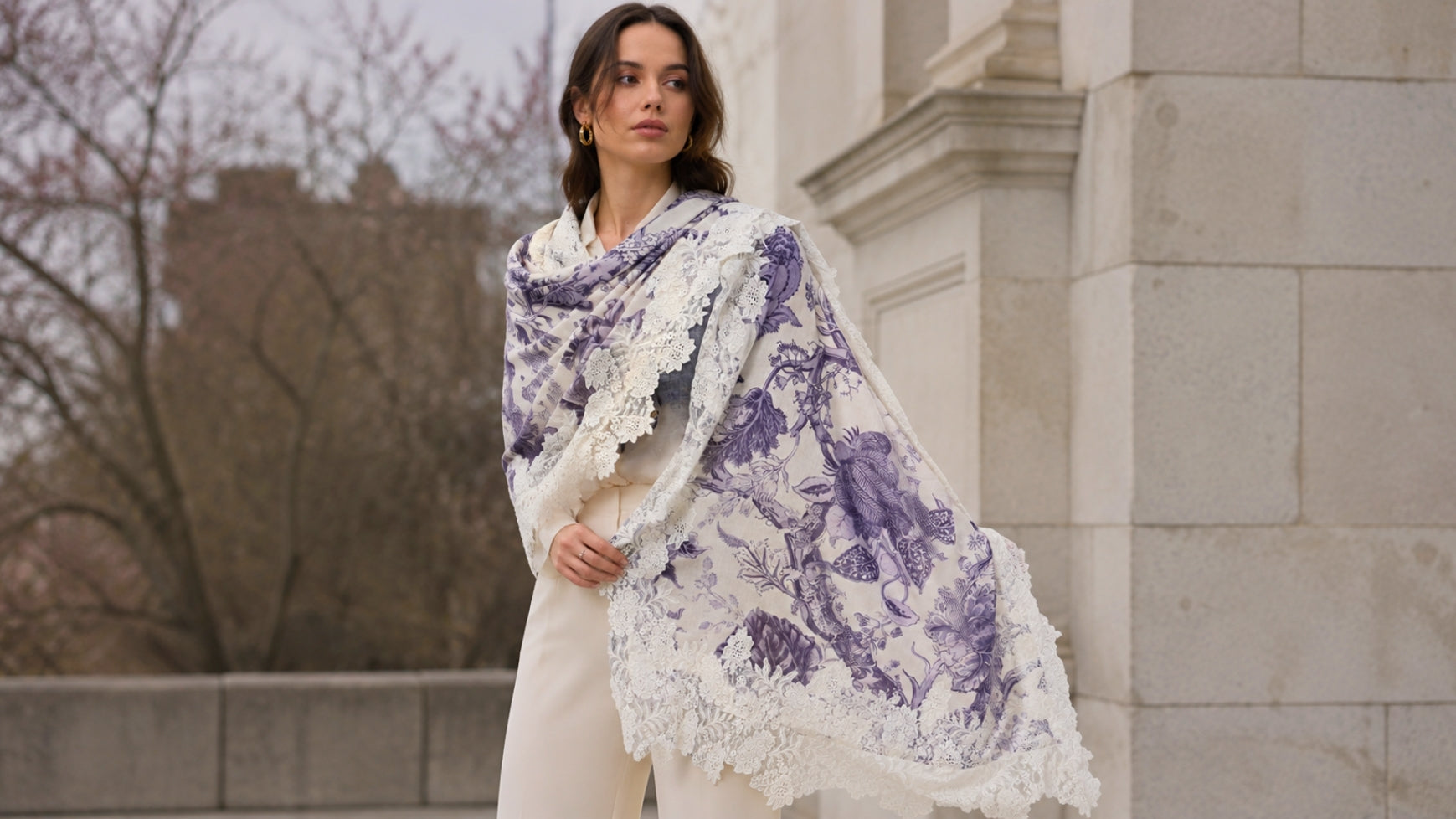
This method is exceptional over strapless or wide-necked eveningwear, where both warmth and coverage are needed but where a structured coat or jacket would disrupt the line of the dress entirely. A pashmina with hand-applied lace borders, embroidery, or artisan detail shows at its full extent in this configuration, the entire surface is visible, and every element of the craftsmanship earns its place in the composition.
The Black Cashmere Pashmina Scarf with Black Ostrich Feathers & Sequin, its intricate feather work and sequin across a ground of pure cashmere, is precisely the kind of piece that transforms this simple styling method into something genuinely memorable at an evening occasion.

The European Loop
The European loop works as well in pashmina as in any heavier fiber, and in pashmina, the fineness of the material means it packs into the loop with considerably less bulk than a wool scarf would produce in the same space. Fold the pashmina in half to locate the midpoint, place that midpoint at the front of the neck, bring both ends around to the back, thread them through the loop, and draw gently until settled at the collarbone.
Because pashmina is so light, this configuration sits comfortably under a coat collar throughout the day and adds measurable warmth without the compression that a bulkier material creates in the same position. It is the choice for active daily wear, the configuration you reach for on a cold morning when you want warmth without any sense of being wrapped.
The Stole
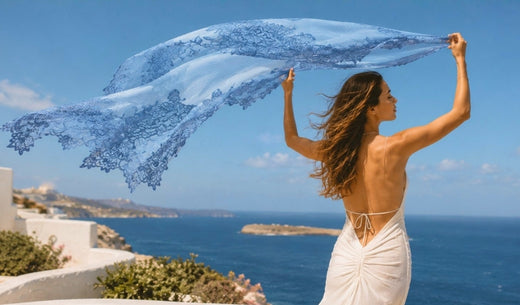
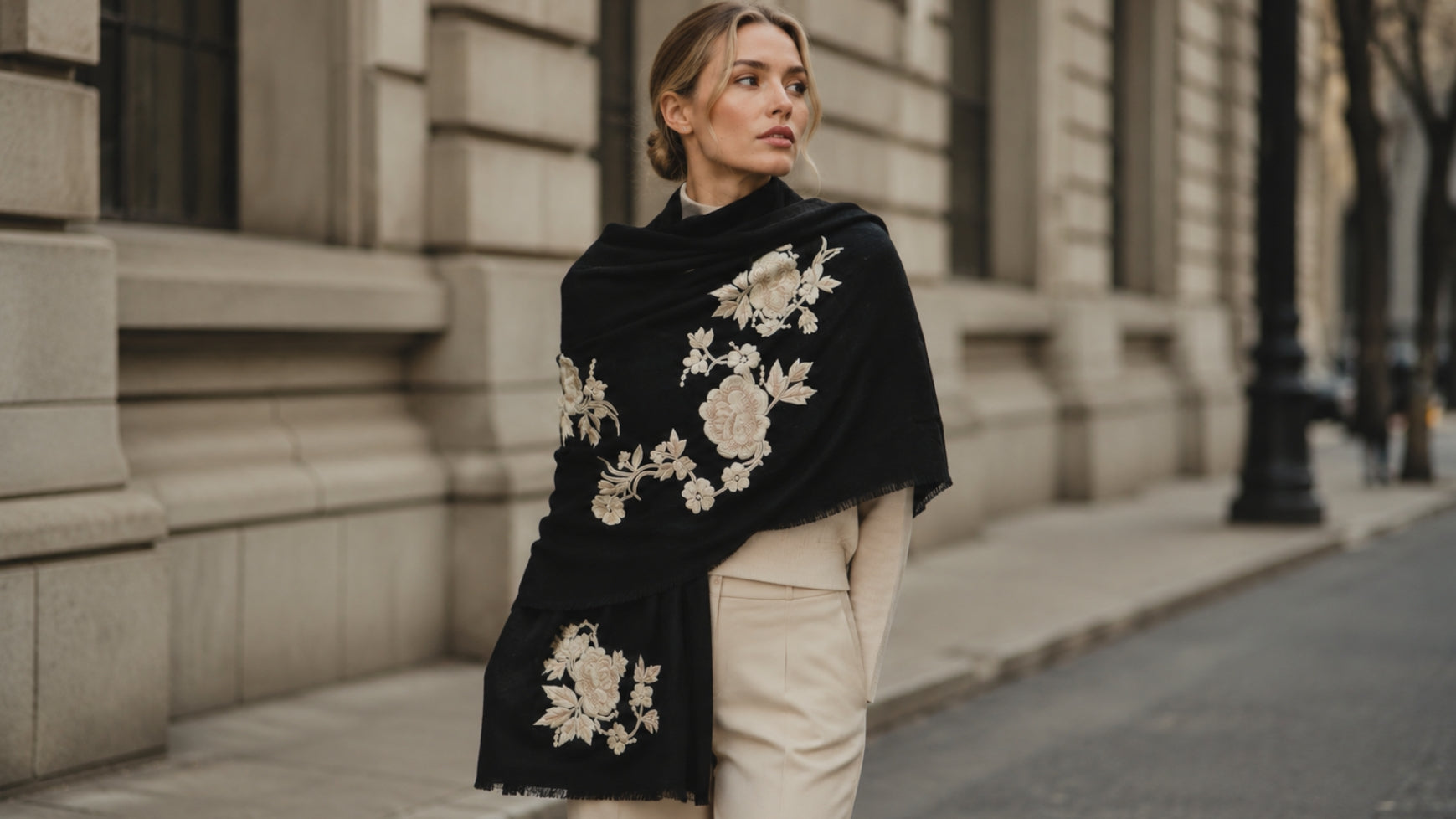
The stole is among the oldest configurations for wearing a pashmina, and it retains its authority because it honors the full length of the fabric rather than gathering or condensing it. Drape the pashmina over one shoulder with both ends falling down the front and back of the body, or lay it across both shoulders with one end brought deliberately across the chest in an asymmetric cascade.
A pashmina with hand-woven borders, embroidered edges, or lace detailing shows with particular authority in the stole configuration, the full length of the piece is visible and unobstructed, and every element of its making becomes part of the visual statement.
The Belted Wrap
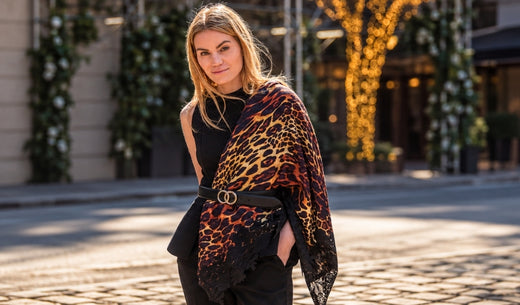
Drape the pashmina across both shoulders and secure it at the natural waist with a slim belt in a complementary neutral. The gathered folds above the belt should fall generously; resist the impulse to smooth them. The texture and volume above the waist are the point of the style, and the contrast between the structured belt and the flowing pashmina above it creates a silhouette that reads as fully considered.
Over a simple dress or wide-leg trousers, the belted pashmina wrap is a complete look in itself, one that requires no further layering, no additional jewelry, and no further decision-making
The Travel Wrap
The pashmina's combination of warmth, lightness, and packability makes it the definitive travel accessory. It compresses to almost nothing, weighs under 200 grams, and functions seamlessly across the full arc of a long journey: European loop at the airport, open drape across the lap on the aircraft, shawl wrap on arrival. Nothing else in a carry-on accomplishes as much across as many hours. The cashmere pieces in the Maneesha Ruia collection that sit adjacent to pure pashmina offer the same principles of lightness and refined warmth across a broader range of weights and finishes.
How to Care for a Pashmina Scarf
A Grade A pashmina cared for properly does not simply last, it improves. The fiber softens slightly with each careful wash, the drape deepens, and the hand becomes more familiar and more beautiful over the years of wearing. That improvement depends entirely on the quality of the care it receives.
Dry cleaning is the safest and most recommended method for all pure pashmina pieces, and it is the correct choice, without exception, for any piece with hand embroidery, beadwork, sequins, lace borders, or applied detailing. Communicate the fiber content and any surface embellishment to your dry cleaner before proceeding.
Hand washing is appropriate for plain pashminas without surface embellishment. Fill a basin with cold water, never warm, never hot, as heat causes pashmina to felt and shrink irreversibly. Add a small amount of pH-neutral detergent or a specialist wool wash. Submerge the scarf and allow it to soak for no more than five minutes without agitation, scrubbing, or wringing. Rinse twice in water at the same temperature; temperature changes, not simply heat, cause felting. Lift the scarf horizontally from the water rather than holding it by one end; the weight of the water will stretch the wet pashmina. Lay it flat on a clean, dry towel, roll the towel to absorb excess moisture, then unroll and reshape to the original dimensions on a fresh surface. Never hang a wet pashmina.
Storage requires equal attention. Fold rather than hang; hanging causes the fiber to stretch along the fold line at the hanger over time. Store in a breathable cotton or linen bag, never a sealed plastic bag, which traps moisture and can cause yellowing. Use cedar blocks or dried lavender to deter moths; pashmina, like all fine natural fibers, is vulnerable to moth damage. Keep pieces away from direct sunlight, which causes fiber degradation and color fade. After wearing, allow the piece to rest for 24 hours before folding and storing. This allows any moisture absorbed from the body to dissipate and the fibers to return to their natural position.
Pilling is a natural and expected property of short-fiber natural textiles. It is not a sign of inferior quality; it is a property of the fiber itself and occurs most commonly where the scarf rubs against a rough coat or a bag strap. Remove pills gently with a specialist cashmere comb or a fine fabric shaver, working in short, light strokes. After de-pilling, the surface of the pashmina returns to its original smoothness.
Why Grade A Is Worth the Investment
The difference between a Grade A pashmina and a lower-grade cashmere or blended substitute is not subtle; it is substantive, and it is visible in the hand within seconds of touching the piece. Grade A pashmina is selected for exceptional fineness, processed to preserve the natural crimp and elasticity of the fiber, and finished by hand at every stage. It drapes with a softness no mid-grade fiber replicates, holds color with the integrity that AZO-free dyes and GOTS-certified processing provide, and retains its quality across decades of careful wear.
At Maneesha Ruia, every piece in the pure pashmina collection meets this standard. The fiber is sustainably sourced from heritage herds in the Himalayan highlands, hand-finished by skilled artisan communities under fair-trade conditions, and dyed using pigments that are safe for the skin and faithful to the color across the full life of the piece. These are not seasonal accessories. They are pieces designed to last as long as the wardrobe they belong to, and to improve alongside it.